
L’Agulhas
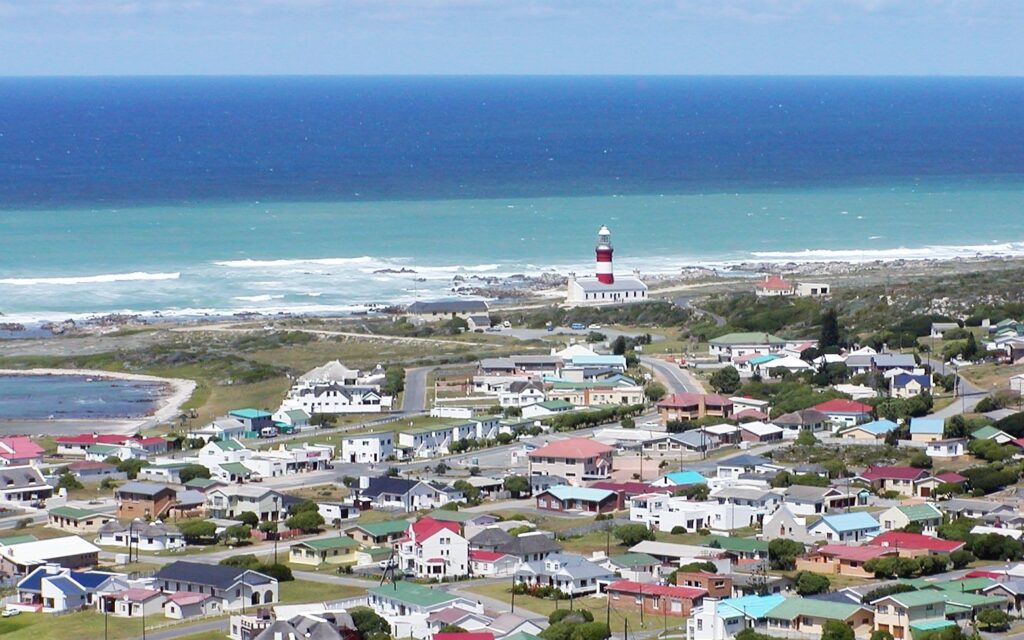
L’Agulhas is something of a destination apart — not strictly part of the Garden Route, but often visited as a side trip from Mossel Bay or Cape Town. Here is what you need to know about this unique place.
The southernmost point of an entire continent L’Agulhas — from the Portuguese word for “needles”, referring to the sharp rocks that break the surface — is above all famous for being the southernmost point of the African continent. It is here, and not at the Cape of Good Hope as many believe, that the true southern tip of Africa lies. A simple stone cairn and a sign mark this symbolic spot where two oceans officially meet: the Atlantic to the west and the Indian Ocean to the east.
Where two oceans meet The official dividing line between the two oceans runs precisely through Cape Agulhas. In reality, the waters are not visually very different at this point — there is no spectacular wave or dramatic colour change as some might imagine — but the geographical symbolism is powerful. You are standing literally at the junction of two of the world’s greatest oceans, at the very tip of a continent.
The lighthouse The Cape Agulhas lighthouse is one of the oldest and most beautiful in South Africa, built in 1849 and the second oldest in the country. It is now a national monument and houses a small museum dedicated to the maritime history of the region, the many shipwrecks caused by the treacherous rocks and the unpredictable currents of this coastline, long feared by sailors.
A stark and wild landscape Unlike the golden beaches and lush forests of the Garden Route, the landscape around Agulhas is flat, windswept and almost lunar. The vegetation is low-lying — mainly fynbos, South Africa’s endemic heathland — constantly battered by strong winds. The ocean is rough, black rocks protrude everywhere, and the horizon seems endless. There is something profoundly melancholic and magnificent about this landscape.
The Agulhas National Park The cape is protected by the Agulhas National Park, which preserves one of the richest fynbos ecosystems in the region. This unique biome, inscribed as a UNESCO World Heritage Site as part of the Cape Floristic Region, is home to an extraordinary diversity of plant life, with hundreds of endemic species. It is a paradise for botanists and lovers of understated nature.
The village of L’Agulhas The small village of L’Agulhas itself is modest and unpretentious — a handful of holiday homes, a restaurant, and an unapologetic end-of-the-world atmosphere. It is not a developed tourist destination, which gives it an authentic and unspoiled character. The population is small, the mood calm and somewhat timeless.
Shipwrecks This coastline is historically one of the most dangerous for navigation in the world, with hundreds of recorded shipwrecks over the centuries. The colliding currents of two oceans, unpredictable winds and hidden rocks have claimed countless vessels. The most famous is the Meisho Maru, a Japanese trawler that ran aground in 1982 whose rusting hull is still visible on the rocks not far from the cape.