Bo-Kaap
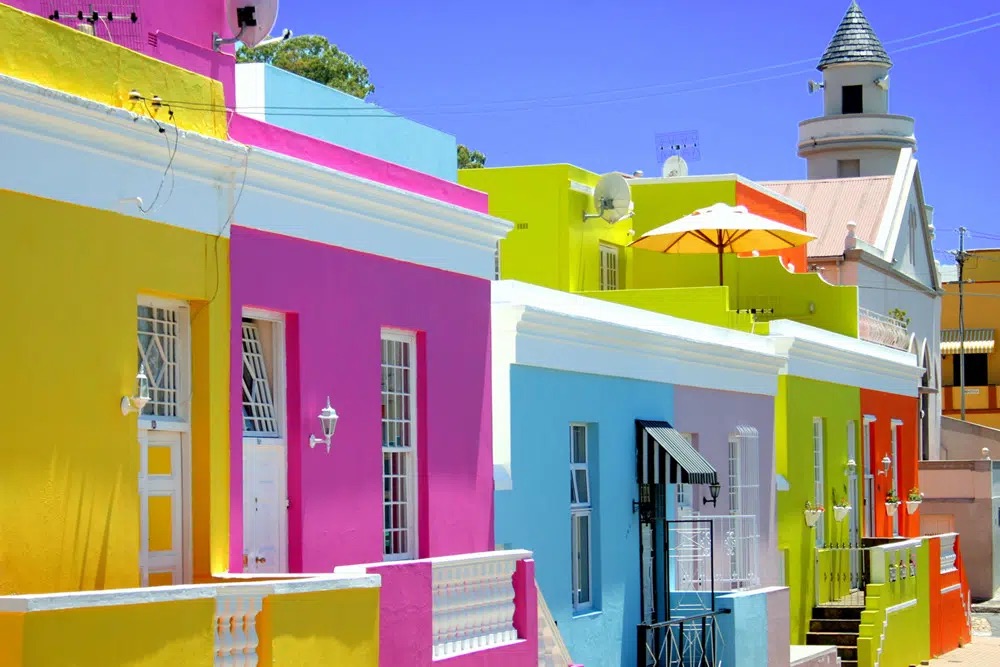
Bo-Kaap is one of Cape Town’s most photographed, most colourful and most historically rich neighbourhoods. Perched on the slopes of Signal Hill, just a few minutes’ walk from the city centre, it is a place where visual beauty and historical depth overlap in a striking way.
The rainbow houses The image that has travelled the world is that of its cobbled lanes lined with houses painted in bold, vivid colours — sunshine yellow, cobalt blue, mint green, fuchsia pink, orange, turquoise. This is no tourist marketing exercise: the tradition of painting houses in bright colours stretches back centuries and is deeply rooted in the neighbourhood’s identity. Each owner chooses their own colour, and the overall result is extraordinarily joyful and vibrant, especially in contrast with the grey mountain behind and the blue ocean below. Wale Street and Chiappini Street are the most famous and most photographed.
A history of resistance and survival Bo-Kaap is far more than a colourful neighbourhood — it is one of the most living witnesses to South Africa’s tragic and complex history. The district is the cradle of the Cape Malay community, descendants of the slaves, craftsmen and political exiles brought by the Dutch East India Company (VOC) from Indonesia, Sri Lanka, India, Madagascar and other territories during the 17th and 18th centuries. It is one of the oldest Muslim communities in South Africa, and Bo-Kaap is its historical and spiritual heart.
During apartheid, Bo-Kaap was designated a Coloured area under the racial segregation laws, but paradoxically this classification protected the neighbourhood from demolition and allowed its community to remain together. Today the neighbourhood faces a different challenge: gentrification, which is driving property prices upward and threatening to displace families who have lived here for generations.
Cape Malay culture Over the centuries, the Cape Malay community developed an extraordinary syncretic culture, blending Malay, Indian, African and European influences. This culture is expressed through its cuisine — Cape Malay cooking is one of the most flavourful and distinctive in South Africa, with dishes such as bobotie (spiced minced meat topped with a savoury egg custard), bredie (slow-simmered stew), koesisters (coconut-coated sweet doughnuts) and sosaties (marinated skewers). It is also expressed through music — the ghoema beat, a traditional rhythm played on a barrel-shaped drum, is a Cape Malay invention. And through language — Afrikaans was largely shaped by the words and expressions brought by these communities.
The mosques Bo-Kaap is home to several historic mosques, including the Auwal Mosque, built in 1794 and considered the oldest mosque in South Africa. The five daily calls to prayer echo through the neighbourhood’s lanes and form part of its unique sonic atmosphere. On Fridays, the district comes alive with a particularly intense spiritual and community life.
The Bo-Kaap Museum The Bo-Kaap Museum, housed in one of the neighbourhood’s oldest buildings, traces the history of the Cape Malay community from slavery to the present day. It is modest in size but rich in emotion, offering a deeper understanding of the historical weight behind those colourful facades.
Gentrification — a real tension It would be incomplete to speak of Bo-Kaap without mentioning the current tension surrounding its future. The neighbourhood has become so popular with tourists and wealthy property buyers that prices have soared, threatening to displace families who have sometimes lived here for five or six generations. Residents have organised to resist — through protests, petitions and legal action — in order to preserve the community character and historical identity of the neighbourhood against property market pressures. It is a raw and painful debate that illustrates the post-apartheid tensions around housing, memory and identity in Cape Town.