Cape Point
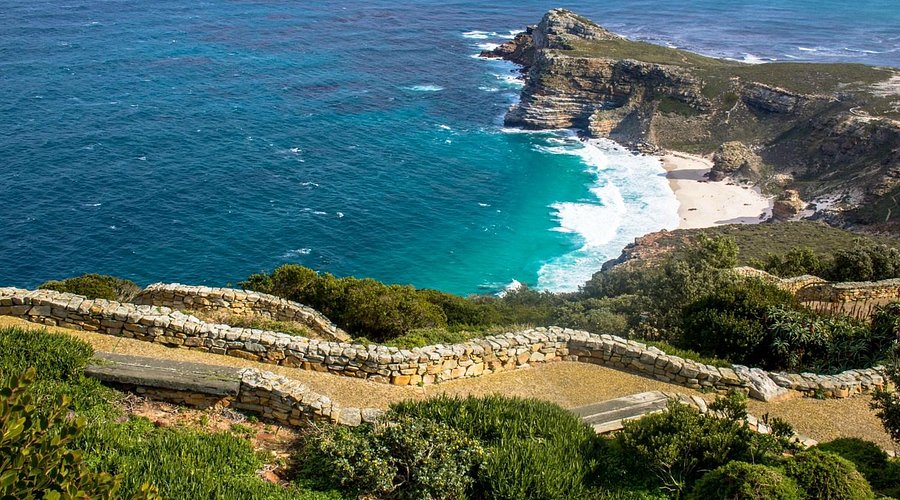
Cape Point is one of South Africa’s most iconic natural sites. Located at the southern tip of the Cape Peninsula, it impresses as much through its wild beauty as through its symbolic and historical significance.
The site Cape Point is a sheer cliff that plunges into the ocean from a height of nearly 250 metres. The landscape here is of rare power — vertiginous drops, waves crashing onto the rocks far below, often violent winds sweeping across the plateau, and an infinite horizon stretching across two oceans. It is a place that gives you a visceral sense of standing at the edge of the world, on the boundary between the Atlantic and the Indian Ocean.
Cape Point forms part of the Table Mountain National Park, which extends across the entire Cape Peninsula and is one of the most visited national parks in South Africa. Entry is paid and also includes access to the surrounding nature reserve.
The lighthouse At the top of the cliff stand two lighthouses. The original lighthouse, built in 1860, was perched so high in the clouds that it was often invisible to passing ships — a factor that caused several shipwrecks. A new, lower lighthouse was built in 1919 and remains active today. The old lighthouse can be reached either on foot via a well-marked trail of around 20 minutes from the car park, or by the Flying Dutchman Funicular, whose name pays homage to the legend of the ghost ship said to have haunted these waters for centuries.
The legend of the Flying Dutchman Cape Point is intimately linked to the legend of the Flying Dutchman — the phantom ship condemned to wander the Cape waters forever, never able to make port. The legend, popularised notably by Wagner’s opera, has its origins in the accounts of sailors attempting to round the cape during terrifying storms. The waters around Cape Point are among the most dangerous in the world, with opposing currents, violent winds and unpredictable weather. Dozens of shipwrecks are recorded along this coast, and the hulks of some wrecks are still visible in calm conditions.
Wildlife Cape Point is a wildlife paradise. The undisputed star is the Chacma baboon — entire troops live within the park and are particularly bold around visitors. They are clever, fast and completely fearless of humans. Car windows must be kept closed and food should never be brought out in the open — baboons are capable of opening backpacks and raiding picnics within seconds. Anti-baboon rangers patrol the park to manage interactions.
Ostriches can also be spotted strolling calmly along the trails, alongside bontebok (Cape endemic antelopes), springbok, leopard tortoises and exceptional birdlife including the Verreaux’s eagle and numerous species of sunbirds and kingfishers.
Hiking trails Cape Point offers several magnificent trails for those wishing to venture beyond the tourist areas. The Lighthouse Trail leads to the old lighthouse with spectacular views. The Shipwreck Trail follows the wild Atlantic coastline past the remains of historic wrecks. For the more adventurous, the Cape of Good Hope Trail allows you to reach the Cape of Good Hope on foot through dense, fragrant fynbos vegetation.
The Cape of Good Hope A few kilometres north of Cape Point lies the famous Cape of Good Hope — often confused with Cape Point, they are in fact two distinct locations. The Cape of Good Hope is not the southernmost point of Africa (that is Cape Agulhas), but it is the southwesternmost point of the Cape Peninsula. A sign and a stone cairn make it a popular spot for photographs — it was here that Bartolomeu Dias landed in 1488 and named the place the “Cape of Storms”, later renamed the “Cape of Good Hope” by the King of Portugal to encourage sailors to use this route to the Indies.
The vegetation All along the road leading to Cape Point, fynbos vegetation is ever-present — this endemic heathland shifts in colour with the seasons, dotted with wild proteas and ericas. During the austral spring (August to October), the flowering is spectacular, transforming the hillsides into carpets of colour.